
So, you’re staring at a Romanian ID card—maybe yours, maybe a relative’s—and you just need one piece of information: the date of birth. Sounds simple, right? Except it’s not where you’d expect. And if you’re like most people, you’ve probably already scanned the card twice, squinted at the tiny text, and wondered, “Why is this so hard to find?”
I get it. Romanian ID cards (Carte de Identitate) aren’t exactly user-friendly. The layout feels like it was designed by someone who wanted to hide the important stuff. And if you’re dealing with this for the first time—maybe for a visa application, a bank form, or just helping a friend—the frustration is real.
Here’s the good news: Once you know where to look, it’s obvious. And I’m going to show you exactly where that is—plus a few other sneaky details most guides skip.
Why This Is Such a Common Problem
Let’s be honest: Most of us don’t study our ID cards. We get them, shove them in a drawer, and only pull them out when absolutely necessary. But when you do need to find something—like the birth date—suddenly, the card turns into a puzzle.
Here’s what usually happens:
- You flip the card front and back, assuming the birth date must be in a prominent spot (like the top, near the name).
- You see Data nașterii but don’t recognize it because, well, it’s in Romanian.
- You second-guess yourself: “Is this the expiry date? The issue date? Wait, no—”
- If you’re dealing with a Romanian passport, you’re really confused because the layout changes.
And if you’re filling out forms in another country? Forget it. One wrong date format (like writing 03/12/1990 instead of 12.03.1990), and suddenly you’re explaining to a bureaucrat why your birthday “doesn’t match.”
The Romanian ID Card: A Quick “What Am I Even Looking At?” Guide
Before we zero in on the birth date, let’s break down the card’s layout. Romanian IDs have two sides, and both are packed with info.
Front Side (The “Important Stuff” Side):
- Top left: Your surname and given names (Numele și prenumele).
- Top right: Your ID card number (Număr carte de identitate)—this is the long alphanumeric code.
- Just below the number: Here’s where things get interesting. You’ll see:
- Data nașterii (birth date)
- Locul nașterii (place of birth)
- Sex (gender)
- Bottom: Issuing authority and expiry date.
Back Side (The “Extra Details” Side):
- Your address (Domiciliu/Reședință).
- Your signature.
- A machine-readable zone (MRZ)—that weird strip of letters and numbers at the bottom.
Where the Birth Date Actually Is (And Why You Missed It)
Alright, here’s the big reveal: The birth date is not at the top. It’s below the ID card number, on the left side of the front.
- Label: Data nașterii (literally “birth date”).
- Format: DD.MM.YYYY—so 15.03.1990 means March 15, 1990, not May 3.
- Font: Small, bold, and easy to overlook if you’re scanning too fast.
Why here? Good question. Romanian IDs follow EU standards, but they also pack a lot of info into a small space. The birth date is grouped with other core identity details (like place of birth) to keep things compact for officials. For the rest of us? It’s just confusing.
Pro Tip: If you’re translating this for a form, some countries want the month written out in Romanian (e.g., martie for March). Always double-check what the form requires.
Mistakes Even Smart People Make
- Assuming It’s on the Back: Nope. The back has your address and the MRZ, but the birth date stays on the front.
- Mixing Up Date Formats: Romanian IDs use day.month.year, not month/day/year. If you’re American, this will trip you up.
- Ignoring the MRZ: That coded strip on the back? It also contains your birth date in a machine-readable format. Useful if you’re scanning the card electronically.
- Confusing ID and Passport Layouts: If you’re used to a Romanian passport, the ID card’s layout feels completely different. (We’ll compare them later.)
Why Does It Matter?
Because at some point, you will need this info:
- Filling out a visa application?
- Opening a bank account abroad?
- Helping a family member with paperwork?
And when that moment comes, you don’t want to be the person holding up the line because you can’t find a birth date on your own ID.
Let Me Show You—Here’s What a Romanian ID Card Actually Looks Like”
Alright, let’s make this visual. Imagine you’re holding a Romanian ID card in your hands. The front is the side with your photo—probably a picture you took on a bad hair day, because that’s how ID photos always go.
Here’s what you’re seeing:
- Top Left Corner:
- Your last name (Nume) and first name(s) (Prenume) in bold.
- Example: POPESCU IOAN ALEXANDRU
- Top Right Corner:
- The ID card number (Număr carte de identitate). This is a mix of letters and numbers, like AB1234567.
- Pro Tip: If you’re ever asked for your CI number (short for Carte de Identitate), this is it.
- Just Below the ID Number (Left Side):
- Data nașterii → This is your birth date.
- Format: DD.MM.YYYY (e.g., 12.05.1985 = May 12, 1985).
- Why the confusion? Because in the U.S., this would be written as 05/12/1985. One wrong flip, and suddenly you’re celebrating your birthday on the wrong day.
- Locul nașterii → Place of birth (e.g., București, România).
- Sex → M (masculin) or F (feminin).
- Data nașterii → This is your birth date.
- Bottom Section:
- Autoritatea emitentă → The office that issued your ID.
- Data expirării → Expiry date (yes, IDs expire too).
What’s on the Back? (And Why It’s Not Just Random Numbers)
Flip the card over. This side is less about you and more about where you live and how machines read your info.
- Domiciliu/Reședință → Your registered address.
- Written in a tiny font, because why make it easy?
- Example: Strada Victoriei, Nr. 12, Bl. 3, Sc. A, Ap. 4, Sector 1, București
- Translation: Victory Street, No. 12, Block 3, Staircase A, Apartment 4, Sector 1, Bucharest.
- Your Signature → Hopefully, it looks like your actual signature and not a scribble from a rushed DMV visit.
- The MRZ (Machine Readable Zone) → That weird strip of letters and numbers at the bottom.
- What’s it for? Airports, border control, and automated systems use this to scan your info.
- Fun fact: Your birth date is encoded here too, but in a format like 850512 (YYMMDD).
Romanian ID Card vs. Passport: Why Are They So Different?
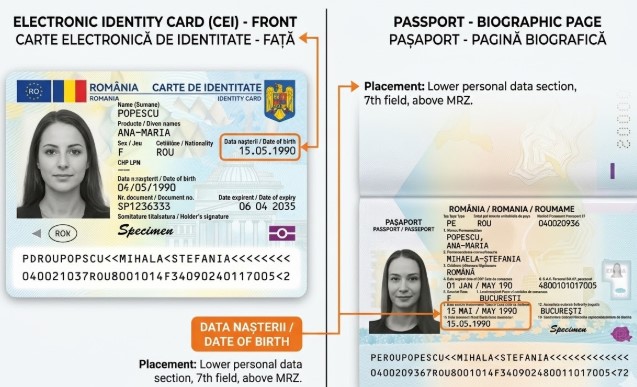
If you’ve ever compared the two, you know: They’re like cousins who refuse to look alike.
| Feature | Romanian ID Card | Romanian Passport |
|---|---|---|
| Birth Date Location | Below ID number (front) | On the data page, under “Data nașterii” |
| Format | DD.MM.YYYY | DD MMM YYYY (e.g., 12 MAY 1985) |
| Language | Mostly Romanian | Romanian + English translations |
| MRZ | On the back | On the data page (same side as photo) |
Why the difference?
- Passports follow international standards (ICAO), so they’re designed to be universally readable.
- ID cards are primarily for EU use, so they prioritize compactness over global clarity.
How to Read the Place of Birth (Because It’s Not Just a City)
The Locul nașterii field isn’t just “Bucharest” or “Cluj.” It’s city + county + country (if born abroad).
Examples:
- București, România → Born in Bucharest, Romania.
- Paris, Franța → Born in Paris, France.
- Sibiu, Județul Sibiu, România → Born in Sibiu, Sibiu County, Romania.
Why this matters:
- Some forms require the exact wording from your ID.
- If you were born outside Romania, the country name will be in Romanian (e.g., Italia for Italy).
What If My ID Card Is Old? (The Pre-2010 Version)
If your card was issued before 2010, the layout is completely different:
- The birth date was on the right side, near the top.
- The text was all caps and even harder to read.
- No MRZ on the back.
If you still have one of these:
- Update it. The new version is more secure and widely accepted.
- Double-check the birth date placement—it’s easy to misread the old format.
What Nobody Tells You About Fixing a Wrong Birth Date on Your ID”
Let me paint you a picture: You’re at the airport, ready to board, and the check-in agent squints at your ID. “Sir, your birth date here says 15.04.1990, but your passport says April 15th. Which is correct?” Your stomach drops. You’ve just been flagged for a mismatch.
This isn’t hypothetical—it happens. And fixing it isn’t as simple as walking into an office and saying, “Oops, my bad.” Here’s the real process, warts and all:
- You’ll need your birth certificate. Not a copy. The original or a certified duplicate. If you don’t have it, you’re starting with a trip to the civil status office (Oficiul de Stare Civilă) where you were born. Yes, even if that’s 300 km away.
- The “quick fix” doesn’t exist. Some offices might tell you to “come back next week.” Others will make you fill out forms in triplicate. Budget 2-4 weeks for this, not 2 days.
- If you’re abroad? The consulate can help, but they’ll mail your new ID to Romania first. You’ll need someone to forward it to you. (Pro tip: Use a trusted courier like DHL or Fan Courier—regular mail is a gamble.)
- The cost: ~50-100 RON (about €10-20), but if you need it urgent, some offices charge extra for “expedited” service. (Spoiler: “Expedited” still means 5 business days.)
Bottom line: If your birth date is wrong, fix it now. Don’t wait until you’re stuck at an airport or a bank.
“Scams That Target Romanian ID Holders (And How to Spot Them)”
I’ve seen it all—fake “ID renewal” websites, “translation services” that sell your data, and even WhatsApp scams where someone claims to be from the “Ministry of Interior” asking for your ID details.
Here’s how they get you:
- “Your ID is expired—click here to renew!” (Link goes to a phishing site.)
- “We can get you a second ID for travel!” (Illegal, and a one-way ticket to fraud charges.)
- “Your ID has a problem—pay €50 to fix it online.” (No, you can’t fix government documents online.)
What to do instead:
✅ Official renewals: Only use ghiseul.ro or your local SPCEP office.
✅ Translations? Go to a notary public (notar public) or a certified translator listed on the Ministry of Justice site.
✅ Lost your ID? File a report at the nearest police station (Poliție) before applying for a new one.
Real talk: If an offer sounds too good to be true (like getting an ID in 24 hours), it’s a scam. Period.
“Can I Really Travel with Just My Romanian ID? (The Honest Answer)”
Short answer: Yes, but not everywhere, and not without risks.
✅ EU/EEA/Switzerland: Your ID is all you need. No passport required.
✅ Domestic flights in Romania: ID works fine.
❌ Turkey, Egypt, or Tunisia: Technically accepted, but airlines often demand passports anyway. (I’ve seen people turned away at the gate.)
❌ USA, UK, or anywhere outside Europe: Passport only. No exceptions.
Gray area: Some Balkan countries (like Serbia or Montenegro) might accept it, but border agents can be unpredictable. Always carry your passport as backup.
Pro tip: If you’re flying Wizz Air or Ryanair, check their ID policies before you book. Some budget airlines are strict about ID vs. passport.
“How to Translate Your Birth Date Without Messing It Up”
You’re filling out a U.S. visa form, and it asks for your birth date in MM/DD/YYYY format. Your ID says 12.05.1990. What do you write?
- For the U.S.: 05/12/1990 (May 12th).
- For the UK/EU: 12/05/1990 (December 5th).
Mess this up, and your application gets flagged. Double-check the form’s instructions—some even want it as 1990-05-12 (ISO format).
If the form asks for the month in words:
- Romanian: Mai
- English: May
- Never mix them up. Write what the form asks for.
FAQ: The Questions You’re Googling at 2 AM
No. Not for travel, not for banking, not for anything official. Some places might let it slide for minor things (like buying a SIM card), but don’t risk it.
Legally, yes. Police can ask for ID at any time. Not having it can mean a fine (though in practice, they’re often lenient if you’re a tourist).
Sometimes. In the EU, yes. Outside the EU? Most rental companies want a passport + driver’s license.
That’s your Cod Numeric Personal—Romania’s version of a social security number. Guard it like your PIN code.
1. In Romania: Go to your local SPCEP office with a police report and your birth certificate.
2. Abroad: Contact the nearest Romanian consulate—they’ll guide you, but it’ll take at least a week.
Final Checklist: Don’t Get Caught Out
Before you hand over your ID for anything important, ask yourself:
✔ Does the birth date match my passport? (If not, fix it.)
✔ Is the MRZ legible? (If it’s scratched, replace it.)
✔ Is the photo still recognizable? (If you’ve changed a lot, update it.)
✔ Is the address current? (If not, you’re technically breaking the law.)
“Need Help? Here’s Who to Call”
- Renewals/Replacements: ghiseul.ro (official site).
- Lost/Stolen IDs: File a report at any police station (Poliție).
- Translations: A notary public or certified translator.
- Travel Questions: Check the IATA Travel Centre (www.iatatravelcentre.com) for up-to-date rules.
Last Word:
Your ID card is more powerful than you think—but only if it’s correct, current, and secure. Treat it like cash: Don’t leave it lying around, don’t share it recklessly, and fix problems immediately.
Got a horror story about ID troubles? Share it in the comments—I’ve heard some wild ones. And if this saved you a headache, pass it on. Someone else is probably Googling this at 3 AM.

 English
  German
  Spanish
  Russian
  Italian
  Portuguese
  Swedish
  Czech
Czech  Polish
  Turkish
  French
  Dutch
Dutch  Chinese
  Ukrainian
  Arabic