
U kijkt dus naar een Roemeense identiteitskaart – misschien die van uzelf, misschien die van een familielid – en u hebt gewoon iets nodig. een stukje informatie: de geboortedatumKlinkt simpel, toch? Behalve dat het niet is waar je het zou verwachten. En als je net als de meeste mensen bent, heb je waarschijnlijk de kaart al twee keer bekeken, je ogen tot spleetjes geknepen om de kleine tekst te lezen en je afgevraagd: “Waarom is dit zo moeilijk te vinden?”
Ik snap het. Roemeense identiteitskaarten (Identiteitskaart) zijn niet bepaald gebruiksvriendelijk. De lay-out voelt alsof die is ontworpen door iemand die gewild Om de belangrijke dingen te verbergen. En als je hier voor het eerst mee te maken krijgt – bijvoorbeeld voor een visumaanvraag, een bankformulier of om een vriend te helpen – dan is de frustratie heel begrijpelijk.
Het goede nieuws is: Als je eenmaal weet waar je moet kijken, is het overduidelijk. En ik ga je precies laten zien waar dat is, plus nog een paar andere handige details die de meeste handleidingen overslaan.
Waarom dit zo'n veelvoorkomend probleem is
Laten we eerlijk zijn: de meesten van ons bestuderen hun identiteitskaart niet. We krijgen er een, stoppen hem in een la en halen hem er alleen uit als het echt nodig is. Maar als je Doen Je moet iets opzoeken, zoals de geboortedatum, en plotseling verandert de kaart in een puzzel.
Dit is wat er doorgaans gebeurt:
- Je draait de kaart om. voor- en achterkantervan uitgaande dat de geboortedatum op een prominente plek moet staan (zoals bovenaan, vlakbij de naam).
- Zie je? Geboortedatum maar ik herken het niet, want ja, het is in het Roemeens.
- Je begint aan jezelf te twijfelen: “Is dit de vervaldatum? De uitgiftedatum? Wacht, nee—”
- Als je te maken hebt met een Roemeens paspoort, jij bent Echt Verward omdat de lay-out verandert.
En als je formulieren invult in een ander land? Vergeet het maar. Eén verkeerd datumformaat (zoals schrijven) is al genoeg. 03/12/1990 in plaats van 12.03.1990), en ineens moet je aan een bureaucraat uitleggen waarom je geboortedatum "niet klopt".
De Roemeense identiteitskaart: een korte handleiding om te achterhalen wat u precies ziet.
Voordat we ingaan op de geboortedatum, laten we eerst de lay-out van de kaart eens bekijken. Roemeense identiteitskaarten hebben twee kantenEn beide boeken zitten boordevol informatie.
Voorkant (de kant met de "belangrijke informatie"):
- Links boven: Uw achternaam en voornamen (Voornaam en achternaam).
- Rechtsboven: Jouw ID-kaartnummer (Identiteitskaartnummer)—dit is de lange alfanumerieke code.
- Net onder het nummer: En nu wordt het interessant. Je zult het zien:
- Geboortedatum (geboortedatum)
- geboorteplaats (geboorteplaats)
- Seks (geslacht)
- Onderkant: Uitgevende instantie en vervaldatum.
Achterkant (de kant met de "Extra details"):
- Jouw adres (Woonplaats/verblijfplaats).
- Jouw handtekening.
- A machineleesbare zone (MRZ)—die rare strook letters en cijfers onderaan.
Waar de geboortedatum Eigenlijk Is (en waarom je het hebt gemist)
Oké, hier komt de grote onthulling: De geboortedatum is niet bovenaan. Zijn onder het identiteitskaartnummer, op de linkerkant van de voorkant.
- Label: Geboortedatum (letterlijk “geboortedatum”).
- Formaat: DD.MM.JJJJ-Dus 15.03.1990 betekent 15 maart 1990, niet 3 mei.
- Lettertype: Small, bold, and easy to overlook if you’re scanning too fast.
Why here? Good question. Romanian IDs follow EU standards, but they also pack a lot of info into a small space. The birth date is grouped with other core identity details (like place of birth) to keep things compact for officials. For the rest of us? It’s just confusing.
Pro Tip: If you’re translating this for a form, some countries want the month written out in Romanian (e.g., martie for March). Always double-check what the form requires.
Mistakes Even Smart People Make
- Assuming It’s on the Back: Nope. The back has your address and the MRZ, but the birth date stays on the front.
- Mixing Up Date Formats: Romanian IDs use day.month.year, not month/day/year. If you’re American, this will trip you up.
- Ignoring the MRZ: That coded strip on the back? It also contains your birth date in a machine-readable format. Useful if you’re scanning the card electronically.
- Confusing ID and Passport Layouts: If you’re used to a Romanian passport, the ID card’s layout feels completely different. (We’ll compare them later.)
Why Does It Matter?
Because at some point, you will need this info:
- Filling out a visa application?
- Opening a bank account abroad?
- Helping a family member with paperwork?
And when that moment comes, you don’t want to be the person holding up the line because you can’t find a birth date on your own ID.
Let Me Show You—Here’s What a Romanian ID Card Eigenlijk Looks Like”
Alright, let’s make this visual. Imagine you’re holding a Romanian ID card in your hands. The front is the side with your photo—probably a picture you took on a bad hair day, because that’s how ID photos always go.
Here’s what you’re seeing:
- Top Left Corner:
- Jouw last name (Nume) and first name(s) (Prenume) in bold.
- Example: POPESCU IOAN ALEXANDRU
- Top Right Corner:
- De ID-kaartnummer (Identiteitskaartnummer). This is a mix of letters and numbers, like AB1234567.
- Pro Tip: If you’re ever asked for your CI number (short for Identiteitskaart), this is it.
- Just Below the ID Number (Left Side):
- Geboortedatum → This is your birth date.
- Formaat: DD.MM.JJJJ (e.g., 12.05.1985 = May 12, 1985).
- Why the confusion? Because in the U.S., this would be written as 05/12/1985. One wrong flip, and suddenly you’re celebrating your birthday on the wrong day.
- geboorteplaats → Place of birth (e.g., București, România).
- Seks → M (masculin) or F (feminin).
- Geboortedatum → This is your birth date.
- Bottom Section:
- Autoritatea emitentă → The office that issued your ID.
- Data expirării → Expiry date (yes, IDs expire too).
What’s on the Back? (And Why It’s Not Just Random Numbers)
Flip the card over. This side is less about you and more about where you live En how machines read your info.
- Woonplaats/verblijfplaats → Your registered address.
- Written in a tiny font, because why make it easy?
- Example: Strada Victoriei, Nr. 12, Bl. 3, Sc. A, Ap. 4, Sector 1, București
- Translation: Victory Street, No. 12, Block 3, Staircase A, Apartment 4, Sector 1, Bucharest.
- Your Signature → Hopefully, it looks like your actual signature and not a scribble from a rushed DMV visit.
- The MRZ (Machine Readable Zone) → That weird strip of letters and numbers at the bottom.
- What’s it for? Airports, border control, and automated systems use this to scan your info.
- Fun fact: Your birth date is encoded here too, but in a format like 850512 (YYMMDD).
Romanian ID Card vs. Passport: Why Are They So Different?
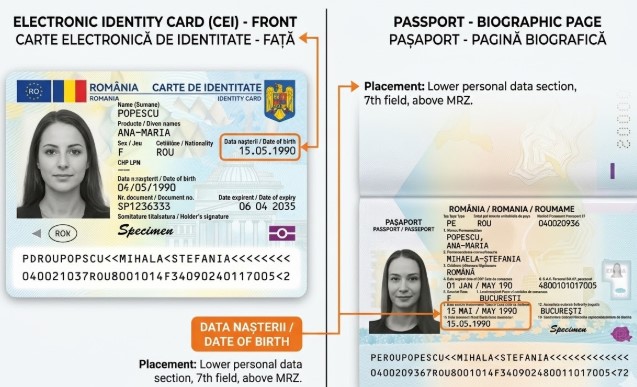
If you’ve ever compared the two, you know: They’re like cousins who refuse to look alike.
| Functie | Romanian ID Card | Romanian Passport |
|---|---|---|
| Birth Date Location | Below ID number (front) | On the data page, under “Data nașterii” |
| Format | DD.MM.JJJJ | DD MMM YYYY (e.g., 12 MAY 1985) |
| Language | Mostly Romanian | Romanian + English translations |
| MRZ | On the back | On the data page (same side as photo) |
Why the difference?
- Paspoorten follow international standards (ICAO), so they’re designed to be universally readable.
- ID cards are primarily for EU use, so they prioritize compactness over global clarity.
How to Read the Place of Birth (Because It’s Not Just a City)
De geboorteplaats field isn’t just “Bucharest” or “Cluj.” It’s city + county + country (if born abroad).
Examples:
- București, România → Born in Bucharest, Romania.
- Paris, Franța → Born in Paris, France.
- Sibiu, Județul Sibiu, România → Born in Sibiu, Sibiu County, Romania.
Why this matters:
- Some forms require the exact wording from your ID.
- If you were born outside Romania, the country name will be in Romanian (e.g., Italia for Italy).
What If My ID Card Is Old? (The Pre-2010 Version)
If your card was issued before 2010, the layout is completely different:
- The birth date was on the right side, near the top.
- The text was all caps and even harder to read.
- No MRZ on the back.
If you still have one of these:
- Update it. The new version is more secure and widely accepted.
- Double-check the birth date placement—it’s easy to misread the old format.
What Nobody Tells You About Fixing a Wrong Birth Date on Your ID”
Let me paint you a picture: You’re at the airport, ready to board, and the check-in agent squints at your ID. “Sir, your birth date here says 15.04.1990, but your passport says April 15th. Which is correct?” Your stomach drops. You’ve just been flagged for a mismatch.
This isn’t hypothetical—it happens. And fixing it isn’t as simple as walking into an office and saying, “Oops, my bad.” Here’s the real process, warts and all:
- You’ll need your birth certificate. Not a copy. The original or a certified duplicate. If you don’t have it, you’re starting with a trip to the civil status office (Oficiul de Stare Civilă) where you were born. Yes, even if that’s 300 km away.
- The “quick fix” doesn’t exist. Some offices might tell you to “come back next week.” Others will make you fill out forms in triplicate. Budget 2-4 weeks for this, not 2 days.
- If you’re abroad? The consulate can help, but they’ll mail your new ID to Romania first. You’ll need someone to forward it to you. (Pro tip: Use a trusted courier like DHL or Fan Courier—regular mail is a gamble.)
- The cost: ~50-100 RON (about €10-20), but if you need it urgent, some offices charge extra for “expedited” service. (Spoiler: “Expedited” still means 5 business days.)
Kortom: If your birth date is wrong, fix it now. Don’t wait until you’re stuck at an airport or a bank.
“Scams That Target Romanian ID Holders (And How to Spot Them)”
I’ve seen it all—fake “ID renewal” websites, “translation services” that sell your data, and even WhatsApp scams where someone claims to be from the “Ministry of Interior” asking for your ID details.
Here’s how they get you:
- “Your ID is expired—click here to renew!” (Link goes to a phishing site.)
- “We can get you a second ID for travel!” (Illegal, and a one-way ticket to fraud charges.)
- “Your ID has a problem—pay €50 to fix it online.” (No, you can’t fix government documents online.)
What to do instead:
✅ Official renewals: Only use ghiseul.ro or your local SPCEP office.
✅ Translations? Go to a notary public (notar public) or a certified translator listed on the Ministry of Justice site.
✅ Lost your ID? File a report at the nearest police station (Poliție) before applying for a new one.
Real talk: If an offer sounds too good to be true (like getting an ID in 24 hours), it’s a scam. Period.
“Can I Really Travel with Just My Romanian ID? (The Honest Answer)”
Kort antwoord: Yes, but not everywhere, En not without risks.
✅ EU/EEA/Switzerland: Your ID is all you need. No passport required.
✅ Domestic flights in Romania: ID works fine.
❌ Turkey, Egypt, or Tunisia: Technically accepted, but airlines often demand passports anyway. (I’ve seen people turned away at the gate.)
❌ USA, UK, or anywhere outside Europe: Passport only. No exceptions.
Gray area: Some Balkan countries (like Serbia or Montenegro) might accept it, but border agents can be unpredictable. Always carry your passport as backup.
Voor een tip: If you’re flying Wizz Air or Ryanair, check their ID policies before you book. Some budget airlines are strict about ID vs. passport.
“How to Translate Your Birth Date Without Messing It Up”
You’re filling out a U.S. visa form, and it asks for your birth date in MM/DD/YYYY format. Your ID says 12.05.1990. What do you write?
- For the U.S.: 05/12/1990 (May 12th).
- For the UK/EU: 12/05/1990 (December 5th).
Mess this up, and your application gets flagged. Double-check the form’s instructions—some even want it as 1990-05-12 (ISO format).
If the form asks for the month in words:
- Romanian: Mai
- English: May
- Never mix them up. Write what the form asks for.
FAQ: The Questions You’re Googling at 2 AM
No. Not for travel, not for banking, not for anything official. Some places might let it slide for minor things (like buying a SIM card), but don’t risk it.
Legally, yes. Police can ask for ID at any time. Not having it can mean a fine (though in practice, they’re often lenient if you’re a tourist).
Sometimes. In the EU, yes. Outside the EU? Most rental companies want a passport + driver’s license.
That’s your Cod Numeric Personal—Romania’s version of a social security number. Guard it like your PIN code.
1. In Romania: Go to your local SPCEP office with a police report and your birth certificate.
2. Abroad: Contact the nearest Romanian consulate—they’ll guide you, but it’ll take at least a week.
Final Checklist: Don’t Get Caught Out
Before you hand over your ID for anything importantStel jezelf de volgende vraag:
✔ Komt de geboortedatum overeen met die in mijn paspoort? (Zo niet, corrigeer het dan.)
✔ Is de MRZ leesbaar? (Als het bekrast is, vervang het dan.)
✔ Is de foto nog herkenbaar? (Als er veel is veranderd, werk het dan bij.)
✔ Is het adres actueel? (Zo niet, dan overtreed je technisch gezien de wet.)
“Hulp nodig? Hier kunt u terecht.”
- Verlengingen/Vervangingen: ghiseul.ro (officiële website).
- Verloren/gestolen identiteitsbewijzen: Dien een melding in bij elk politiebureau (Poliție).
- Vertalingen: A notary public of certified translator.
- Reisvragen: Controleer de IATA-reiscentrum (www.iatatravelcentre.com) voor actuele regels.
Laatste woord:
Uw identiteitskaart is Krachtiger dan je denkt—maar alleen als het correct, actueel en veilig. Behandel het als contant geld: Laat het niet zomaar rondslingeren, deel het niet ondoordacht en los problemen direct op.
Heb je een horrorverhaal over problemen met je identiteitsbewijs? Deel het in de reacties – ik heb al een paar bizarre verhalen gehoord. En als dit je een hoop hoofdpijn heeft bespaard, Geef het door. Waarschijnlijk zoekt iemand anders dit om 3 uur 's nachts op via Google.

 Dutch
Dutch  English
  German
  Spanish
  Russian
  Italian
  Portuguese
  Swedish
  Czech
Czech  Polish
  Turkish
  French
  Chinese
  Ukrainian
  Arabic